Annual Reports
KKR & Co. Inc.'s annual reports contain management's most considered account of the business. These are the sections, passages and visual pages worth opening in the originals preserved in Sources.
KKR & Co. Inc. — FY2025 Annual Report (Form 10-K) — FY2025
The most recent full account of the firm: three segments, $744bn of AUM, and the valuation and clawback mechanics behind the earnings. · Open the full document →
Business Segments — p. 8 · Read the full section →
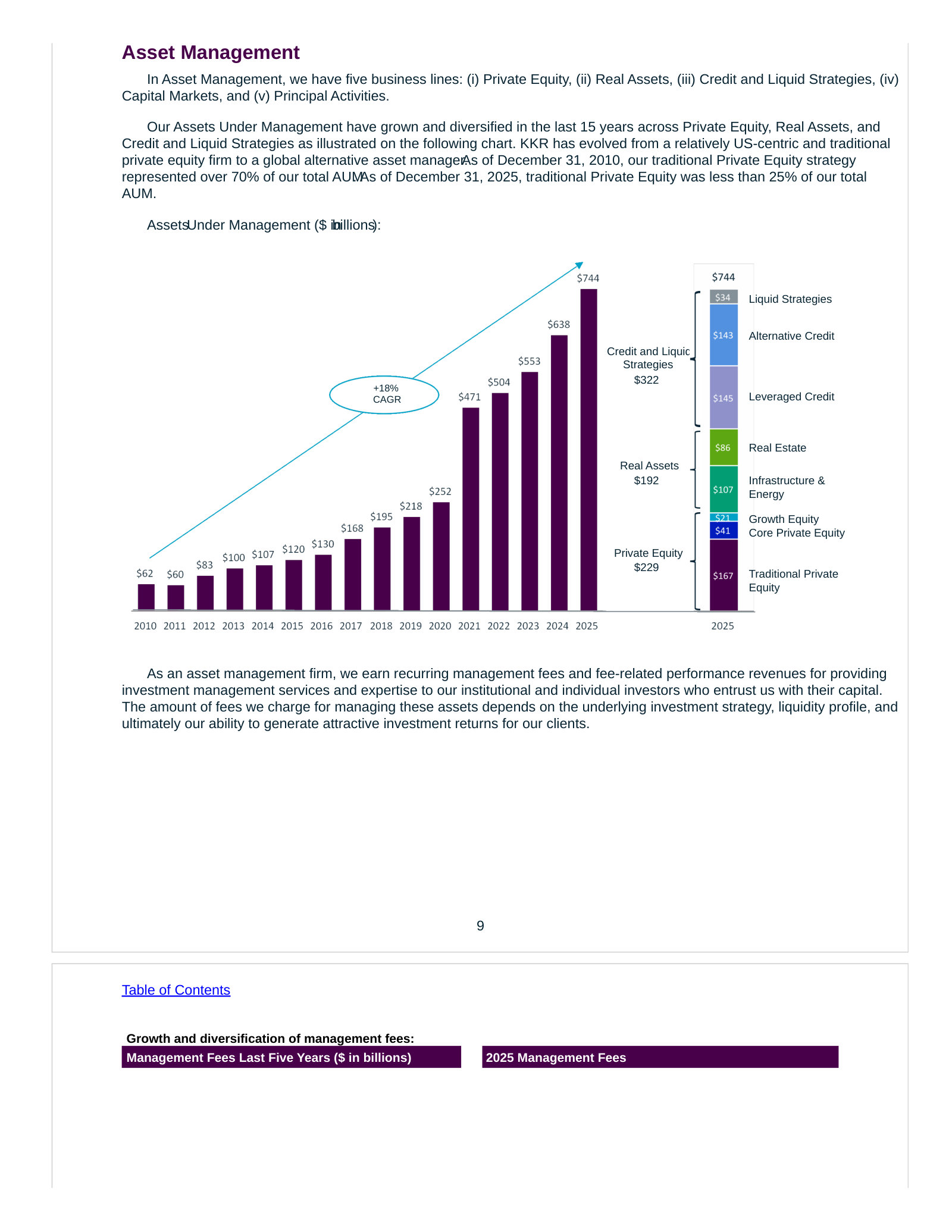
Management's own framing of the firm: three reporting segments, 36 offices, $744bn of AUM, and why the pieces fit together.
Opening description of the firm and the three-segment business model.
KKR is a leading global investment firm that offers alternative asset management as well as capital markets and insurance solutions. We aim to generate attractive investment returns by following a patient and disciplined investment approach, employing world-class people, and supporting growth in our portfolio companies and communities. […] Founded in 1976, KKR pioneered the leveraged buyout strategy and has been a leader of the private equity industry for five decades. […] Our business model of (i) Asset Management, (ii) Insurance, and (iii) Strategic Holdings corresponds to our three reporting segments. […] Importantly, these pieces were built to leverage our core strengths as a firm: investing acumen, capital allocation expertise and our collaborative culture.
p. 8 · Read in context →
Investment Vehicle Structures, Fee Arrangements and Carried Interest — p. 15 · Read the full section →
The revenue mechanics in management's words: management fees, fee-related performance revenues, carry rates, hurdles and netting holes.
Insurance — p. 18 · Read the full section →
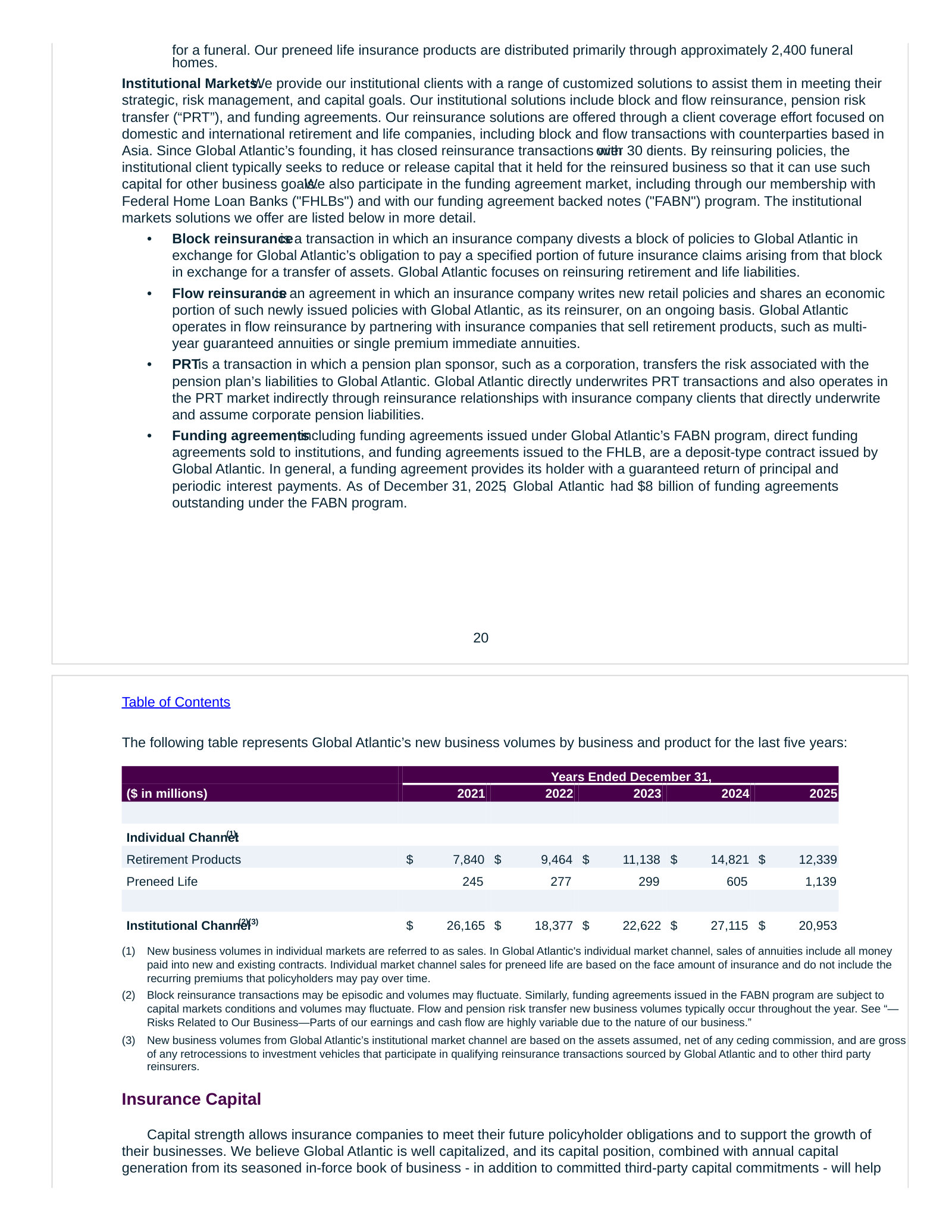
Global Atlantic is now $219bn of the $744bn AUM and a wholly owned balance sheet; this section explains what it sells and to whom.
What Global Atlantic is, and the 2021-2024 path from 60% to full ownership.
Our insurance business operates under the Global Atlantic brand. Global Atlantic is a leading retirement and life insurance company, with an over 20-year track record of providing a broad suite of protection, legacy, and savings products to customers and reinsurance solutions to clients across individual and institutional markets. […] KKR acquired a majority controlling interest in Global Atlantic on February 1, 2021 (approximately 60%), and acquired the remainder of Global Atlantic on January 2, 2024, increasing our ownership to 100%.
p. 18 · Read in context →
Strategic Holdings — p. 21 · Read the full section →
The segment created in Q1 2024: 19 wholly held operating companies whose dividends KKR now reports as a third earnings stream.
Definition, expected income (dividends) and the fee boundary against the Asset Management segment.
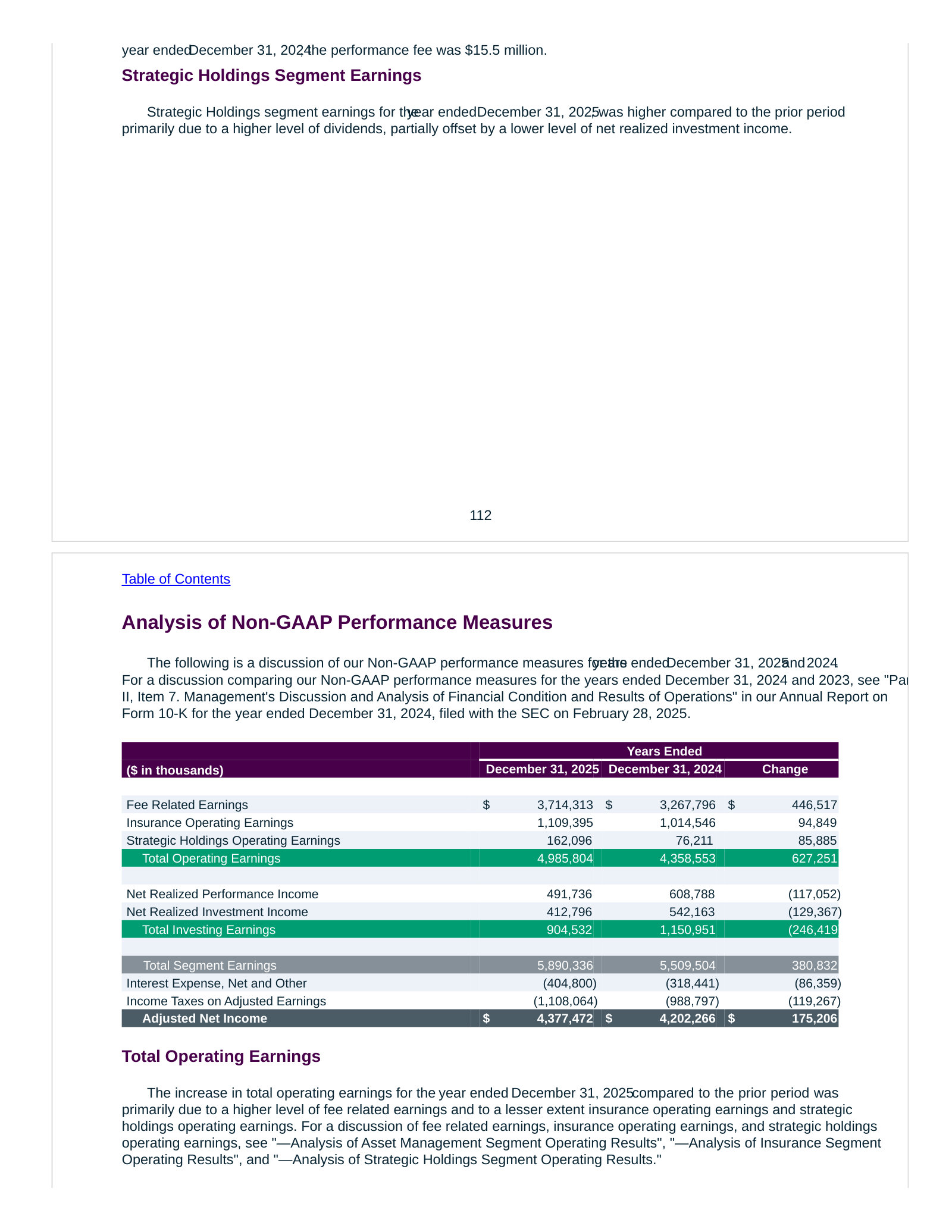
Our Strategic Holdings segment, which we started reporting in the first quarter of 2024, acquires and manages interests in operating companies that are owned by the firm. Today, those companies primarily consist of our participation in our core private equity strategy. We have acquired, and in the future we expect to continue to acquire, other long-term assets outside of, and in addition to, our participation in our core private equity strategy. Strategic Holdings is not limited to acquiring companies in specific industries. We intend to hold the companies in our Strategic Holdings segment over a longer period of time, and we believe most of these companies generally have a lower risk profile than would be typical for an investment through our traditional private equity strategy. We currently expect our Strategic Holdings segment primarily to generate income from the receipt of dividends from our ownership stakes in these businesses and, upon the sale of any ownership stake, realized investment income from such sale. As of December 31, 2025, our Strategic Holdings segment consisted of ou ownership stakes in 19 companies. […] The fees and carried interest paid by the third party investors in our core private equity funds continue to be reported in our Asset Management segment and are not reported in our Strategic Holdings segment.
p. 21 · Read in context →
The agreements governing our carry-paying funds have in the past and may in the future give rise to a contingent obligation that requires us to return or contribute significant cash amounts to our funds and fund investors. — p. 40 · Read the full section →
Clawback is not hypothetical here: KKR discloses a realized carried interest repayment in Q4 2025 on Asian Fund II.
The clawback obligation, stated plainly.
We have in the past and may in the future be required to return carried interest that we have received from investment funds. The partnership documents governing our carry-paying funds across our asset classes include what are often called “clawback” provisions.
p. 40 · Read in context →
Where it bites: employee carry pool, available cash, fundraising - and a repayment already made.
We would continue to be subject to such obligation even if carry has been distributed to current or former employees through our carry pool. If such current or forme employees do not satisfy their share of any clawback obligation, we will be responsible for funding the entire obligation and may need to seek other sources of liquidity to fund such an obligation. […] To the extent one or more obligations were to occur for any one or more of our carry-paying funds, we might not have available cash to satisfy such obligation once it is realized, putting us in breach of the fund’s governing agreements and potentially resulting in a material adverse impact on our ability to raise additional or successor funds in the future. […] including information about realized carried interest repayment in the fourth quarter 2025 relating to our Asian Fund II.
p. 41 · Read in context →
The portion of our AUM we refer to as perpetual capital is not permanent and is subject to change. — p. 43 · Read the full section →
Perpetual capital carries the growth story; management spells out how quickly it can leave, including from the insurance book.
What counts as perpetual capital, and the withdrawal, redemption and surrender routes out of it.
We refer to a significant portion of our AUM as perpetual capital, because this AUM has an indefinite term with no predetermined requirement to return invested capital to investors upon the realization of investments. This AUM includes the capital of our evergreen products, which include investment vehicles registered under the Investment Company Act, certain unregistered investment vehicles like our K-Series offered to individual investors, and listed companies like KREF and Crescent Energy, as well as the capital of our insurance companies. However, in addition to fluctuations based on the valuations of the underlying investments of the AUM, this capital is subject to material reduction, including through withdrawals, redemptions, periodic payments such as dividends or required distributions, and termination of investment advisory agreements, and these reductions may occur with minimal notice. […] Unless the inflows from writing new insurance policies and entering into new reinsurance transactions exceeds outflows to pay contractual obligations, or the valuation of the assets backing our insurance liabilities increases in excess of any expected appreciation, our permanent capital from our insurance subsidiaries and sponsored insurers would be reduced.
p. 43 · Read in context →
Regulations impacting the insurance industry and insurance companies owned by alternative asset managers may adversely affect our business. — p. 51 · Read the full section →
The regulatory question aimed squarely at KKR's model - an alternative manager running an insurer's investment portfolio.
NAIC scrutiny of affiliated investments and ratings, plus possible designation as an internationally active group.
As part of their efforts to address potential risks stemming from an insurance company’s relationship with alternative asset managers that may impact the insurance company’s risk profile, regulators have increased their scrutiny of certain structured investments held by insurance companies, the appropriateness of investment ratings and potential conflicts of interest (including affiliated investments), and potential misalignment of incentives. This growing scrutiny may increase the risk of regulatory actions against our insurance business and could result in new or amended regulations that limit our ability as an investment adviser, or make it more burdensome or costly, to enter into or amend existing investment management agreements with insurance companies and thereby grow our insurance strategy. […] Additionally, the group-wide supervisor for our insurance business is the Indiana Department of Insurance. The Indiana Department of Insurance has informed us that it will be part of the International Association of Insurance Supervisors’ Global Monitoring Exercise, a risk assessment framework to monitor key risks and trends […] At this time, we cannot accurately predict whether we will be named or designated as an IAIG or the impact, if any, on us.
p. 52 · Read in context →
Analysis of Segment Operating Results — p. 98 · Read the full section →
The fee line explained fund by fund - which vehicles switched on, which stepped down to invested capital, what was retroactive.
Drivers of the $639m increase in management fees, by business line.
The increase in Private Equity management fees was primarily attributable to (i) management fees commencing at North America Fund XIV in the second quarter of 2025 and (ii) management fees earned on new capital raised over the past twelve months at our private equity K-Series vehicles, net of certain revenue sharing arrangements. The increase was partially offset by (i) a lower level of management fees earned from Ascendant (our U.S. middle market traditional private equity fund) due to management fees earned on new capital raised in 2024 that were retroactive to the start of the fund’s investment period and no such retroactive fees were earned in the current year, (ii) a decrease in management fees earned from North America Fund XIII as a result of entering its post-investment period in the second quarter of 2025, and now paying fees based on invested capital rather than committed capital, and (iii) no management fees earned from Asian Fund II in the current period due to the termination of management fees in the fourth quarter of 2024. […] The increase in Real Assets management fees was primarily attributable to (i) management fees commencing at Globa Infrastructure Investors V in the third quarter of 2024, (ii) management fees earned on new capital raised over the past twelve months at our infrastructure K-Series vehicles, net of certain revenue sharing arrangements, and (iii) a higher level of management fees earned from Global Atlantic primarily due to the growth in assets from inflows. The increase was partially offset by a decrease in management fees earned from Global Infrastructure Investors III and Asia Pacific Infrastructure Investors due to a decrease in invested capital during the current year.
p. 99 · Read in context →
Fair Value Measurements — p. 131 · Read the full section →
For an alternative manager the valuation policy is the business model: Level III marks set carried interest and investment income.
Management's own caution on the uncertainty in Level III valuations.
Our investments and financial instruments are impacted by various economic conditions and events outside of our control that are difficult to quantify or predict, which may have a significant impact on the valuation of our investments and, therefore, on the carried interest and investment income we realize. […] There is inherent uncertainty involved in the valuation of Level III investments, and there is no assurance that, upon liquidation, KKR will realize the values reflected in our valuations. Our valuations may differ significantly from the values that would have been used had an active market for the investments existed, and it is reasonably possible that the difference could be material.
p. 131 · Read in context →
KKR & Co. Inc. — FY2023 Annual Report (Form 10-K) — FY2023
Included for one section only: the two-segment firm as management described it before Strategic Holdings was carved out in 2024. · Open the full document →
Our Business — p. 14 · Read the full section →
The last 10-K before Strategic Holdings existed: two segments, and perpetual capital framed as a strength rather than a risk.
More annual reports
KKR & Co. Inc. — FY2024 Annual Report (Form 10-K) — FY2024 · 558 pages · First 10-K to report Strategic Holdings as a segment and the first full year owning 100% of Global Atlantic. · Open →
KKR & Co. Inc. — FY2022 Annual Report (Form 10-K) — FY2022 · 598 pages · The down-market year: fundraising, realizations and carry in a period when exits largely stopped. · Open →
KKR & Co. Inc. — FY2021 Annual Report (Form 10-K) — FY2021 · 586 pages · The year the insurance business arrived: first report consolidating Global Atlantic after the February 2021 acquisition. · Open →